The Book That Quietly Rewired How I Think About Discipline
There is a particular kind of reading that happens when you are rebuilding.
You are not reading for entertainment. You are not reading to learn something interesting. You are reading the way a person lost in the dark reads a map — with urgency, with the specific hope that this page, this paragraph, this sentence might be the one that finally tells you where you are and what to do next.
Most books disappoint that reader. Not because they are bad books. Because they were written for a different version of you — the version that is already stable, already decided, already in motion. They assume a foundation that disruption has removed.
The book I want to tell you about this week did not disappoint that reader.
It landed. Not because it told me what I wanted to hear. Because it told me something I was not ready to hear — and I was, finally, ready to hear it.
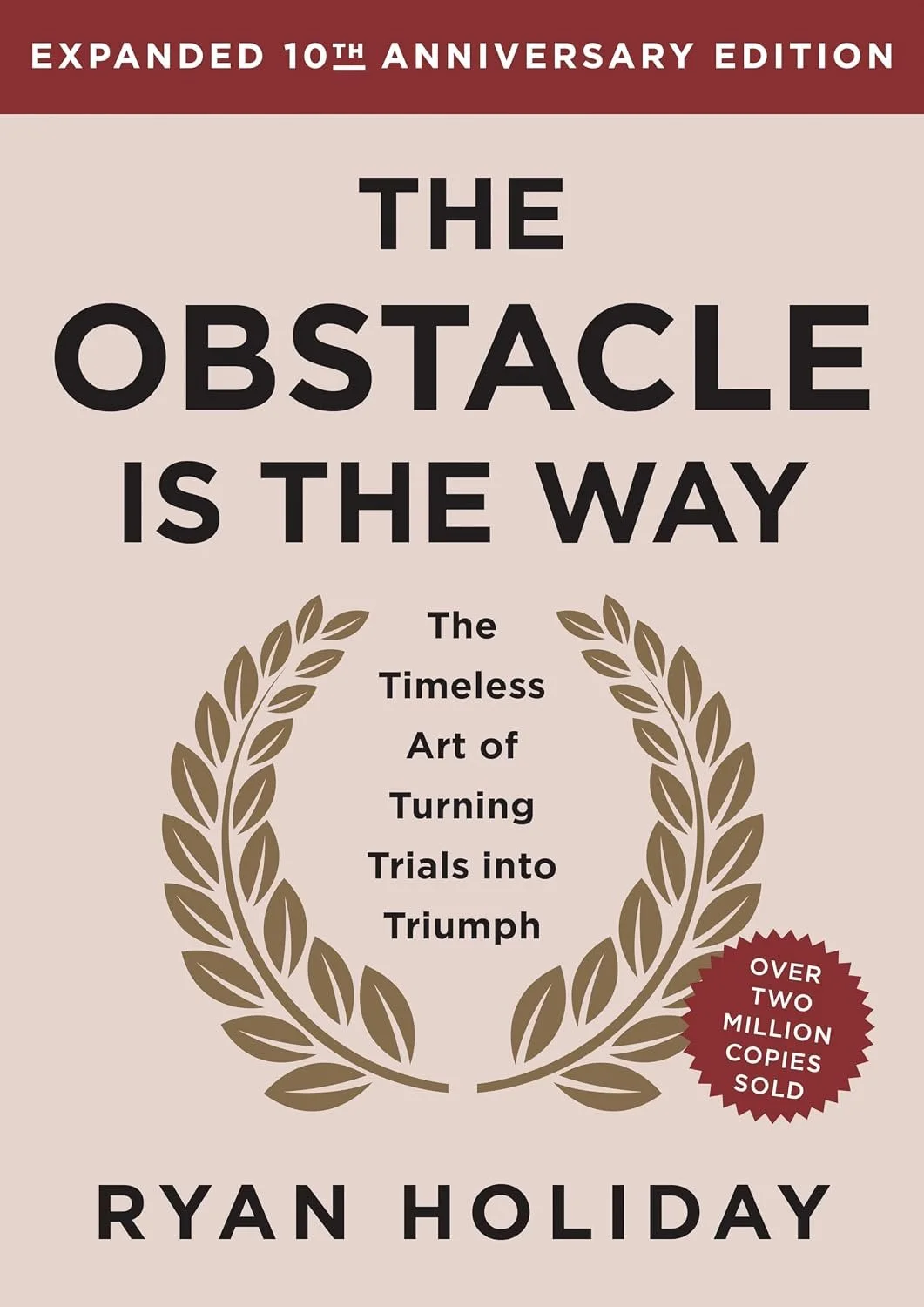
The Obstacle Is the Way by Ryan Holiday.
I want to be specific about when I read this and why it matters. I had read versions of this philosophy before — Marcus Aurelius, Epictetus, fragments of Stoic thought picked up in various places. I thought I understood it. I did not. Not in the way that changes how you actually move through the world.
I read it during a period of significant disruption. Career. Relationship. Identity. The kind of collapse that does not announce itself clearly but arrives gradually — until one day you look around and nothing is recognizable, including yourself.
That is the version of me that read this book. And that version understood it completely differently than any earlier version would have.
What the book actually says
The premise is deceptively simple: the obstacle is not in the way of the path. The obstacle is the path.
Holiday draws on Stoic philosophy — primarily Marcus Aurelius, who ruled an empire while simultaneously losing children, managing war, and facing his own mortality with a clarity that reads as almost impossible from a modern vantage point — to argue that the external circumstances of our lives are largely beyond our control. What we control entirely is our perception of those circumstances and our response to them.
This is not positive thinking. It is not reframing. It is something significantly harder and significantly more useful — it is the practice of meeting reality exactly as it is, without flinching, and then asking: what does this require of me?
Not what do I wish were different. Not what should have happened. What does this, exactly as it is, require of me right now?
That question changes everything.
Why this book lands differently during rebuilding
Most self-help content about discipline is written from a position of strength. It assumes you have energy to direct, motivation to harness, a baseline of stability from which to build new habits.
Rebuilding rarely offers any of those conditions.
What rebuilding offers instead is a stripped-down version of reality — one in which the usual scaffolding of identity, routine, relationship, and purpose has been removed, and you are left with something more essential. Something closer to the actual question: who are you when none of the external structures are holding you up?
Holiday's Stoicism — and more precisely, Marcus Aurelius's practice of it — speaks directly to that stripped-down condition. Because Marcus was not writing from comfort. He was writing from the front lines of his own life, in real time, trying to hold together his character when everything external was in flux.
The Meditations — which Holiday draws on extensively — are not a philosophy of optimization. They are a philosophy of survival with integrity. Of doing the right thing when it is inconvenient, unglamorous, and unwitnessed. Of treating each obstacle not as evidence that the universe is against you but as the specific material from which your character is being built.
That is a very different relationship with difficulty than the one most of us were taught.
The passage that rewired something
There is a passage Holiday quotes from Marcus Aurelius that I have returned to more times than I can count since reading this book. I will not reproduce it here — the book is worth your ten dollars and your full attention — but the essential idea is this:
The impediment to action advances action. What stands in the way becomes the way.
When I first read that line I did not believe it. I read it as a nice idea — the kind of thing that sounds profound and means nothing when your life is actually falling apart.
The second time I read it — three months later, from a different position — I understood that it was not a nice idea at all. It was a description of a mechanism. A literal account of how character is actually built.
Not through ease. Not through the absence of disruption. Through the specific friction of meeting your life as it is and continuing to act with integrity anyway.
That is what discipline actually is. Not the willpower to do hard things. The commitment to continue being the person you have decided to be — even when, especially when, the circumstances make it inconvenient.
What this has to do with rebuilding
In the Five-Stage Framework, Stage III is Reconstruction — the stage of rebuilding with intention. Of deciding, from the rubble of what disruption left behind, what you are actually going to build and who you are going to be while you build it.
Reconstruction is the stage most people find hardest. Not because it requires the most pain — Stage II Disruption holds that distinction. But because Reconstruction requires something disruption temporarily removes: agency. The belief that your choices matter. That what you do today is building something real.
Holiday's book is a Reconstruction book. It is for the person who has done enough Stage I and Stage II work to be standing up again — and is now asking the harder question: not just how do I survive this, but who do I become because of it?
The answer he offers, and that Marcus Aurelius lived, is this: you become the person who met the obstacle without flinching, who used the resistance as material, and who arrived on the other side not unchanged but more themselves than before.
It means becoming who you could not have been without it.
Other books worth your time during rebuilding
Since this Insight is about reading, here are four more — each for a different stage:
For Stage I — Foundation:When the Body Says No by Gabor Maté. On the relationship between chronic stress, emotional suppression, and physical illness. Uncomfortable, necessary, and deeply clarifying about what the body has been holding.
For Stage II — Disruption:The Body Keeps the Score by Bessel van der Kolk. The landmark text on trauma, nervous system dysregulation, and why talk therapy alone is often insufficient for deep healing. Dense but worth every page.
For Stage IV — Integration:Man's Search for Meaning by Viktor Frankl. On finding purpose not despite suffering but through a conscious relationship with it. Short, devastating, and one of the most important books ever written about the human capacity to rebuild.
For Stage V — Expansion:The War of Art by Steven Pressfield. On resistance — the internal force that keeps creative, ambitious, rebuilding people from doing the work they know they are here to do. Read this when you are ready to move and something inside you keeps saying not yet.
Each of these books arrived for me at exactly the right stage. I hope they arrive for you the same way.

SUPPORT THE WORK
All contributions help sustain Alexandria Tava, LLC and its independent work in education, media, advocacy, and public wellbeing—particularly around abuse of power, injustice, rebuilding, and human wholeness.