Is It Intuition—or Hypervigilance After Trauma?
A warning rises. Your chest tightens. You want to leave the room, end the call, cancel the plan.Is that wisdom — or an old wound reacting to something that only resembles the original threat?"Trust your gut" is true often enough to be popular, and wrong often enough to be dangerous when the gut in question has been trained by harm.
The myth: Your intuition is always right. If something feels off, it is off.
The reality: Trauma recalibrates your alarm system. It becomes more sensitive to anything associated with the original danger — which means it can go off accurately, or go off at a resemblance. From the inside, both feel identical.
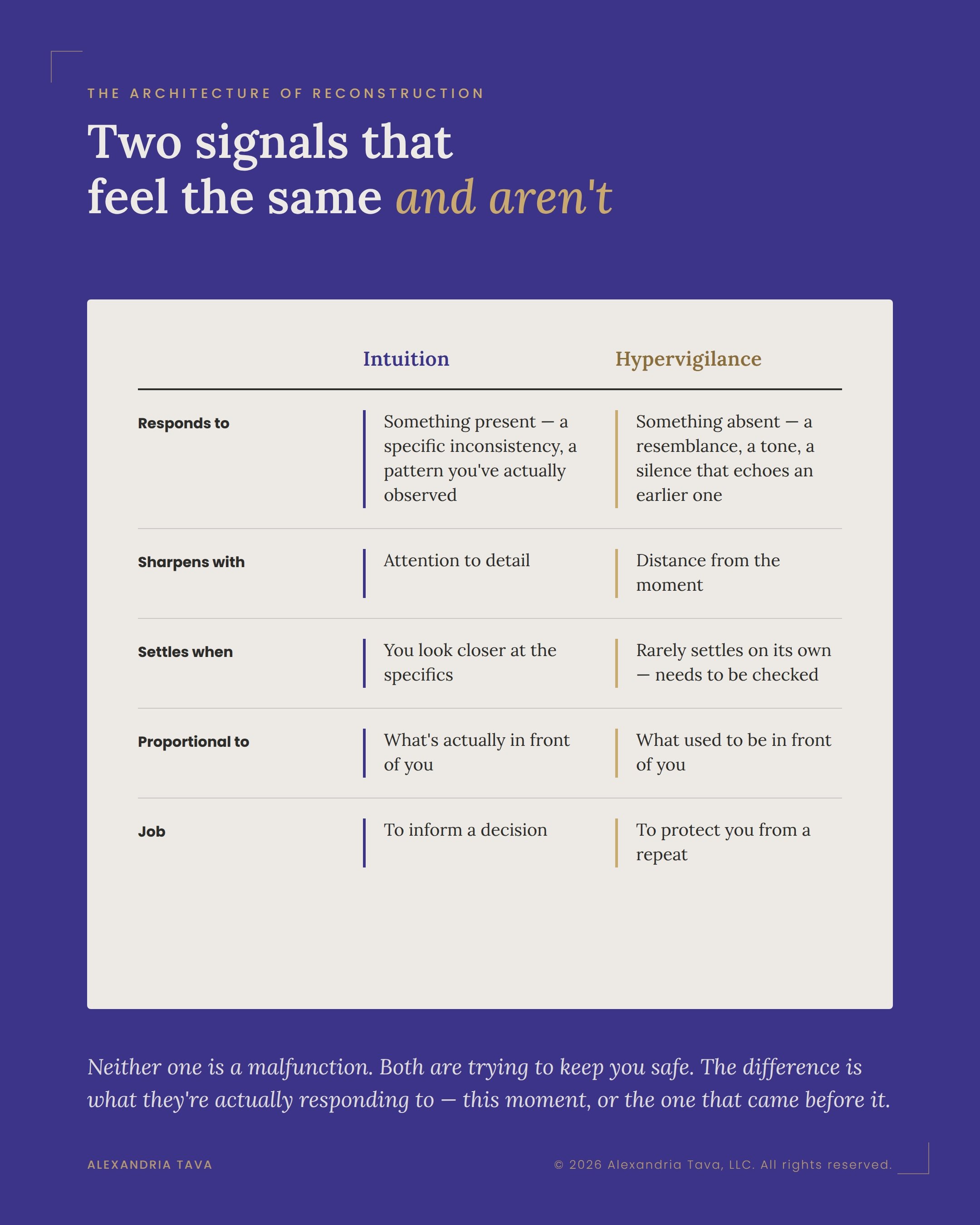
Neither one is a malfunction. Both are trying to keep you safe. The difference is what they're actually responding to — this moment, or the one that came before it.
Three quick scenarios
A. A new coworker raises their voice once, in a stressful meeting, and you spend the rest of the day certain they can't be trusted. → Worth checking: is this a pattern, or one bad hour?
B. Someone repeatedly cancels plans at the last minute, offers no real explanation, and you feel your stomach drop each time. → Worth trusting: this is a specific, observed, repeating behavior — not a resemblance.
C. A partner goes quiet after a disagreement, and the silence itself — not anything they've said — makes you brace for the worst. → Worth slowing down on: silence can mean many things. What does this silence, from this person, over time, actually tend to mean?The test isn't how loud the alarm is. It's whether you're reacting to something happening now, or to something that merely rhymes with what happened before.
Rebuilding a system you can trust
You don't have to choose between always trusting your gut and always overriding it. Both extremes have a cost — one leaves you defenseless against real patterns, the other repeats the exact dynamic that damaged your trust in the first place.
The middle ground is discernment: take the alarm seriously enough to investigate it, and take yourself seriously enough not to accept its conclusion without evidence. Do that enough times, and your nervous system gets new data to learn from — the same way it once learned the old danger.
You're not trying to silence the alarm. You're teaching it what's actually happening now.
Continue building that discernment with Reclaim Your Power.